Why Is Canadian Real Estate So Expensive? (2015–2025)
Canada's housing crisis did not happen because of one single event. It was the result of 10+ years of multiple forces stacking on top of each other: extremely low interest rates, rapid population growth, housing supply shortages, investor speculation, restrictive zoning laws, cheap borrowing and easy credit, construction bottlenecks, government policy incentives, and COVID-era money printing and remote work. By 2025, Canada became one of the least affordable housing markets in the developed world.
- The Foundation Was Built Before 2020
The crisis actually started long before COVID. From roughly 2008 onward, Canada entered an era of historically low interest rates after the global financial crisis. The Bank of Canada reduced rates to stimulate the economy, and borrowing became cheap.
When Interest Rates Fall, Everything Changes
When interest rates fall, several critical things happen simultaneously:
- Monthly mortgage payments become cheaper
- Buyers qualify for larger loans
- Investors borrow more aggressively
- Asset prices rise
This caused Canadian home prices to steadily climb through the 2010s. At the same time, housing increasingly transformed from a place to live into an investment asset. This psychological shift was critical. People began believing: 'Canadian real estate only goes up.' That belief itself increased demand.
Research from the Canada Mortgage and Housing Corporation (CMHC) and economists consistently points to falling mortgage rates as one of the biggest drivers of long-term housing inflation. When you can borrow money at 2.5% instead of 5%, you can suddenly afford to pay significantly more for the same property. This bidding power inflation became a self-reinforcing cycle throughout the 2010s.
The Interest Rate Effect
- The "Hidden" Costs: Development Charges
One of the least discussed reasons for high prices is the "tax on building." Municipalities rely heavily on Development Charges (DCs) to fund infrastructure like sewers, roads, and parks. In cities like Toronto and Markham, these fees can account for 8% to 16% of the total cost of a new condo.
The Math
- The Cost of Construction and Labor
Building a home in 2025 is significantly more expensive than it was five years ago. This is a common hurdle mentioned in realtor website guides when discussing market conditions.
- Material Volatility: Tariffs on steel and aluminum, combined with fluctuating lumber prices, have added thousands to the "hard costs" of construction.
- The Labor Shortage: Roughly 20% of Canada’s construction workforce is nearing retirement. The lack of skilled trades (plumbers, electricians, framers) has pushed wages higher, further inflating the final sale price.
- Monetary Policy and the "Wait-and-See" Effect
The Bank of Canada’s journey from a 0.25% policy rate in 2021 to 5.0% in 2024, and back down to 2.25% by late 2025, has created a "rollercoaster" effect for those pursuing organic seller leads.
While lower rates generally make borrowing cheaper, they also act as "fuel" for the market. When rates drop, "sidelined" buyers rush back in, leading to bidding wars that quickly erase any savings from lower interest payments.
Debt Service Ratio (DSR)
- Regional Price Disparity
It’s important to note that "Canada" isn't one single market. We are seeing a massive "compression" where buyers are fleeing expensive hubs (Ontario/BC) for more affordable provinces (Alberta/The Prairies). This shift is critical for agents to understand when writing listing descriptions.
- British Columbia: Nov 2025 Benchmark Price: $901,100 (-5.8% YoY)
- Ontario: Nov 2025 Benchmark Price: $757,400 (-5.2% YoY)
- Quebec: Nov 2025 Benchmark Price: $527,300 (+6.5% YoY)
- Alberta: Nov 2025 Benchmark Price: $498,400 (-1.6% YoY)
- Saskatchewan: Nov 2025 Benchmark Price: $360,500 (+7.2% YoY)
- Zoning and "The Missing Middle"
For decades, Canadian cities were zoned for two things: high-rise glass towers or single-family detached homes. This lack of "The Missing Middle" (townhomes, triplexes, and courtyard apartments) forced families to compete for a limited stock of detached houses, driving those prices into the stratosphere.
While recent zoning reforms (like allowing four-plexes as-of-right) are a step forward, it will take years for this new inventory to hit the market. Avoiding common listing mistakes remains vital during this transition.
Detailed Analysis: The Structural Crisis
Policy and Zoning Constraints
Even when there is land and money to build, local rules often block or slow projects that could add more homes. Many municipalities have restrictive zoning that favors detached houses and limits building heights. These regulatory barriers alone can add 5–15% to the cost of new housing in major cities.
Financialization and Tax Rules
Canada’s tax systems treat housing as both shelter and a favored investment asset. The principal residence exemption on capital gains encourages households to see their home as a tax-advantaged investment. In certain cities, investors are estimated to account for 10–20% of purchases, adding extra demand that competes directly with end users.
Stagnant Wages vs. Rising Prices
While home prices have surged, incomes for many Canadians have not kept pace. This widening affordability gap hits younger people and new immigrants hardest, who must enter the market at today's elevated levels without the benefit of past price appreciation.
The disconnect between wages and housing costs represents one of the most fundamental and troubling aspects of Canada's housing crisis, creating a generational divide that threatens social mobility and economic opportunity. In the 1980s and 1990s, the average Canadian home cost approximately 3-4 times the average household income—a ratio that made homeownership achievable for most middle-class families within a reasonable timeframe of saving and career progression. By 2025, this ratio had deteriorated dramatically to 8-10 times average household income in major cities, and even higher in Toronto and Vancouver where it exceeded 12-15 times in many neighborhoods. This means that while a family earning $80,000 annually might have been able to afford a $300,000 home in the past, that same family today would need to afford a home costing $800,000-$1,200,000—an impossibility without substantial family wealth, dual high incomes, or taking on dangerous levels of debt. The math is stark: from 2015 to 2025, average home prices in Toronto increased approximately 80%, while median household incomes increased only about 25%. In Vancouver, the disparity was even worse, with home prices more than doubling while incomes grew modestly. This widening gap has created a situation where even well-educated professionals with good jobs—teachers, nurses, engineers, accountants—find themselves unable to afford homes in the cities where they work. A typical first-time buyer in Toronto by 2025 needed to save $100,000-150,000 for a down payment, which at a savings rate of $1,000 per month would take 8-12 years to accumulate—during which time prices often continued rising faster than savings could grow, creating a treadmill effect where the goal constantly moved further away. This has forced many young Canadians into difficult choices: remaining renters indefinitely, moving to smaller cities or rural areas far from job opportunities, relying on family wealth for down payment assistance (the 'Bank of Mom and Dad'), or taking on extreme debt loads that leave them financially vulnerable to any economic shock. The result is a growing class divide where homeownership increasingly depends not on individual merit, hard work, or career success, but on family wealth and timing—whether you or your parents bought property before prices exploded. This threatens the fundamental promise of upward mobility that has been central to the Canadian middle-class dream.
The wage-price disconnect has particularly severe implications for essential workers and new immigrants who form the backbone of Canada's economy and society. Healthcare workers, teachers, retail employees, hospitality staff, and other essential service providers often earn modest incomes despite performing critical work, yet they are expected to live in or near the expensive cities where their services are needed most. A nurse in Toronto earning $70,000 annually would struggle to afford even a modest condo, let alone a family home, yet hospitals desperately need nursing staff and cannot function without them. Similarly, new immigrants—who Canada actively recruits through ambitious immigration programs to address labour shortages and support economic growth—arrive to find that the housing costs in Toronto, Vancouver, and other major cities where jobs are concentrated consume 50-70% or more of their income, making it nearly impossible to save for a down payment or achieve the homeownership that was often part of their Canadian dream. This creates a cruel irony where Canada welcomes hundreds of thousands of newcomers annually to fill essential roles and contribute to the economy, but the housing market makes it extraordinarily difficult for them to establish stable, secure lives. The affordability crisis also has profound implications for business competitiveness and economic productivity. Companies in Toronto and Vancouver increasingly struggle to attract and retain talent because the high cost of living erodes the value of salaries that might be competitive elsewhere. A software engineer offered $120,000 in Toronto might find that after housing costs, they have less disposable income than they would earning $90,000 in a more affordable city, leading to talent drain toward lower-cost regions or the United States. This brain drain and difficulty attracting workers ultimately undermines the economic vitality of Canada's largest cities and reduces overall productivity and innovation. The wage-price gap also forces many Canadians to take on unsustainable debt levels, with household debt-to-income ratios in Canada among the highest in the developed world, creating financial fragility that makes the entire economy vulnerable to shocks like job losses, interest rate increases, or economic downturns. Until wages catch up to housing costs—or more realistically, until housing costs come down to align with wages—this fundamental imbalance will continue to erode affordability, reduce economic mobility, and threaten the social fabric that has made Canada an attractive destination for immigrants and a prosperous society for its citizens.
Foreign Buyers and Policy Responses
Foreign capital has historically flowed into Canadian residential real estate, particularly in luxury segments. While the federal government implemented a temporary ban on non-Canadian purchases, many analysts argue that demand-side measures alone cannot fix the underlying structural supply issues.
Urbanization and Geographic Constraints
Canada is a massive country, but demand is heavily concentrated in a few metropolitan areas where jobs and services are located. In cities like Vancouver and Toronto, geographic limits (mountains, oceans, Greenbelts) create intense competition for finite land, further pushing prices upward.
"The bottom line is that Canada doesn't just need lower interest rates—it needs a massive reduction in 'red tape' and a historic surge in actual construction. Every word in your listing counts, and every insight in your business strategy matters. Explore our tools to stay ahead in this challenging market."
Key Takeaway
The Hidden Cost of "Old School" Websites
Maintaining a custom real estate website is notoriously expensive and time-consuming. You are often paying developers thousands of dollars upfront, plus monthly retainer fees, just to keep the lights on.
The Trap
This is where RealtyChat changes the game. It solves these headaches by letting agents manage their own listings instantly without writing a single line of code.
"RealtyChat gives you a personalized, AI-powered link to share with buyers—eliminating the need for expensive hosting while delivering features that actually convert."
1. The "Master Link" (Link-in-Bio)
Replace your fragmented social presence with one elegant Master Link. It hosts all your listings, your "Contact Agent" button, Calendly booking link, and direct icons for TikTok, Instagram, and Facebook. It's the only link you'll ever need in your bio.


2. AI Listing Assistant (The Location Expert)
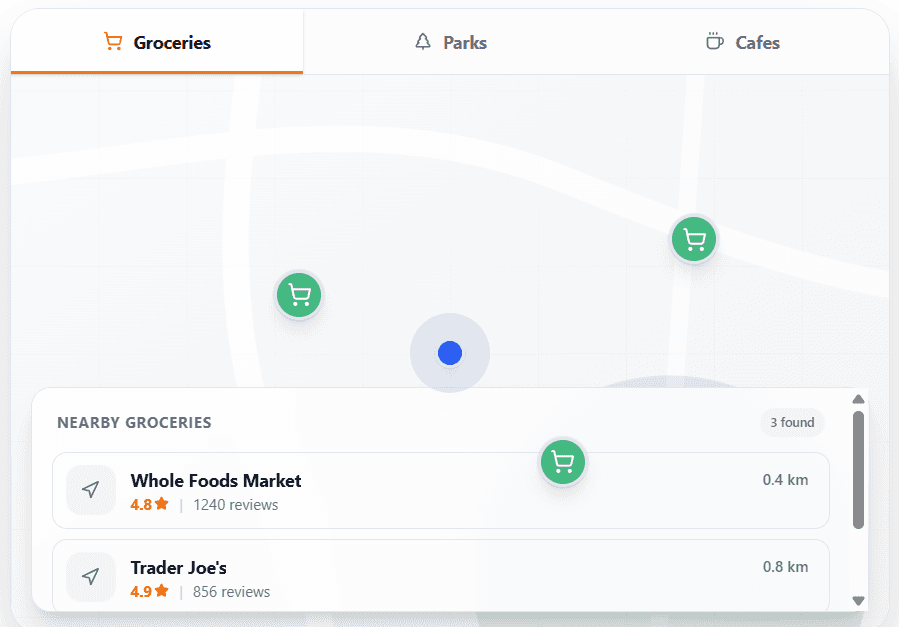
Every individual listing comes with a dedicated Location Expert AI. Powered by Google Maps and Gemini, it uses the property address to answer hyper-local questions with surgical precision. Buyers can ask "Where are the nearest Asian restaurants?", "How far is the gym?", or about local schools, getting accurate, real-world data instantly.
3. Lead AI Chatbot (Your Digital Twin)
Located on your Master Link-in-Bio, this chatbot acts as your digital twin. You can configure it with your own knowledge base (PDFs, text files) to represent your brand 24/7. It greets visitors, collects lead requirements automatically, and proactively recommends listings from your entire portfolio that match their needs.

4. AI Leads Dashboard
Stop guessing who is visiting your links. Your AI Leads Page gives you a real-time view of every lead captured by your Link-in-Bio chatbot. View their email, property requirements, and the full conversation history so you can step in when they're ready to talk.


5. Neighborhood & Lifestyle Intelligence
Our platform leverages Google's Gemini AI combined with Google Maps data to create rich, location-aware listing descriptions, automatic commute analysis, and interactive lifestyle maps for every listing.
Instant Neighborhood Analysis:
- ✓Commute Analysis: Instant drive vs. transit times to major work hubs.
- ✓Lifestyle Maps: Auto-populated maps with nearby grocery stores, parks, and schools.
- ✓AI Descriptions: Compelling narratives with precise walking distances to local cafes and gyms.
Start Now
Ready to Upgrade Your Real Estate Business?
Join thousands of agents who are saving time and closing more deals with RealtyChat's AI-powered tools and beautiful link-in-bio listings.
Subscribe to our newsletter
Get the latest real estate market analysis and trends delivered straight to your inbox.